Sunday, September 20, 2015

Learning to Teach


I had a strange experience recently. I won’t go into detail, but suffice it to say that a new student, whom I had already had a consultation with the week before, came for one lesson and decided that I made her feel really uncomfortable. It’s a strange experience for me because in twenty-six years of teaching, I’ve never had anyone say that. It ate away at me for days as I tried to go over the lesson we had in my head and figure out what I had done wrong.

There is a real joy for me in teaching guitar, but I admit it took me awhile to be any good at it. That’s probably true for most teachers, and I suppose some never really get any good at it! I mean, all of us remember the good teachers we had in school, and the not-so-good ones. Teaching goes beyond “knowing” something, and that’s the real secret.

My first experience with teaching was nothing to do with music at all. I was a computer operator (that’s what they called us in the 80s!) at the Vancouver Public Library, and over the period that we became automated, I had to teach a lot of the staff how to use a computer. Many of these people were librarians who were older and who had barely even heard the word computer, let alone used one! I had a knack for teaching, and out of our little group of computer operators, my boss gave me most of the teaching duties. I really enjoyed it. I created a bit of a patter, complete with jokes and quips, and I slowly and carefully, and joyously, brought those librarians into the digital age. It was very satisfying.

Teaching guitar was simply an idea that came to me in a daydream. I realized that I could take what I had learned through teaching at the library and teach guitar instead.  And that if it went well enough, I could quit my part-time job in radio and teach at home so I didn’t have to keep my girls in daycare. I first taught through the city in one of those community centre programs. I wrote up a proposal for teaching an adult guitar class and they accepted it. A lot of students signed up, which was great, but then I realized the disadvantage. There were really too many of them, and I had never taught guitar before, so I didn’t know how to make sure they were all getting something out of it. I’m sure some of them had fun, but knowing what I know now, I’m convinced that some did not benefit much from the class.

A year or two after that, I began teaching out of my own home through a smaller non-profit organization, and eventually I simply became self-employed. I tell my students now that I didn’t really learn to play guitar until I’d been teaching it for awhile! But mostly, I learned how to teach.

These days, a lot of students come to me after having either tried to teach themselves, or having a friend or a family member try to teach them, and they blame themselves for not being able to learn in those situations. The truth is that we all learn differently, and just because your brother can pick up a guitar and teach himself, doesn’t mean he can teach you!

Teaching, for me, is about making a connection with a person and then learning how to communicate with them what they need to do. Some people learn more visually, others learn more by ear, and for many it’s a combination of things that lead to understanding how to do it. Not only that, but playing an instrument is a physical experience, and for many, holding it for the first few times feels completely foreign. Then there are the sore fingers and strange hand cramps that come with creating those strange little chord shapes at first.

My job, besides the instruction part, is to give a lot of positive encouragement. Some people are very nervous, most are self-deprecating, but there are those who are particularly hard on themselves or impatient at not being able to learn more quickly. Interestingly enough, most kids are not that way. Kids are used to the idea of learning, and they generally don’t care as much about making mistakes, so most of them just plow through and do their best. But as adults, we have different, and higher, expectations of ourselves. We just want to be able to pick it up and play, and although there are those who can do exactly that, it’s the exception rather than the rule.  And how we squirm at the idea of making a “bad noise”!

A lot of people talk about how nervous they feel, and I completely understand that. A few years ago, I took an adult piano class for the first time, and it was really good for me to be the student for awhile, and to experience that nervousness and “feeling stupid”! I try to remember that feeling every time a student expresses his or her anxiety. The most extreme case happened many years ago, when I had a student who would not play in front of me. She simply asked me to show her how to play something, and then she’d go home and apparently play it herself. I say “apparently” because I never once heard her play! She only took lessons for a short while because even our arrangement made her too anxious. So when a students tells me about their anxiety, I can relate that story as a way of hopefully make them feel like it’s not so bad!

I’ve been told that one of my strengths is my easy going nature, and my emphasis has always been on having fun with playing. There is nothing more satisfying than when I see a student have an “aha!” moment…when they see their playing improve or when their fingers suddenly “know” what they’re doing.  But if you’re not having fun with it at least some of the time, then learning the guitar isn’t worth it as far as I’m concerned!  I always try to meet people first to see if we’re a good fit, and I encourage people to do that with anyone they are looking at as a prospective teacher. I don’t teach classical or jazz or theory, so there’s no point in taking on a student who is interested in that. But it’s also about the personality and teaching style. I’ve heard a few stories over the years about other teachers to know that some of them don’t really know what they’re doing.  If you want to teach, then learn how to!

I’m lucky that what I teach is something that makes people feel good. And I never stop learning. Even my recent experience will still be a lesson to me, something that will make me even more conscious and sensitive to the people who give me the great pleasure of teaching them.

IJ

Sunday, July 5, 2015

Wallace Mountain


It was a sunny, late spring afternoon in 1972 when I arrived home from school to find a mysterious box sitting on the kitchen table. My Dad was outside working in the garden, as he typically was every spring and summer.

When I walked up to the table and read the label on the top of box, I was startled. “Herein lie the remains of Fanny H. Jackson”.

I stared at it for a long time. My curiosity compelled me to want to open the box, to see what human ashes actually look like. But I was scared. I was not quite 15 years old and still grieving the death of my mother only a month or so earlier, and to think that all that was left of her was in that cardboard box was almost too much to bear.

But my curiosity eventually won and I removed the tape and slowly lifted the lid.

Just a couple of weeks ago, forty-three years after discovering my mothers ashes, I found myself sitting in the back yard under the gazebo with my two daughters, holding an urn, this time with my father’s ashes. We had each decided to write a letter to him which we planned to burn and mix in with his ashes before we took him to the place where he wanted them scattered. Neither of my daughters had ever seen ashes before, and they were a little leery about them just as I had been all those years ago. We started our little burning ceremony and then spoke about what we had written. I mentioned how I written to my Dad that he was a good father, and one of my daughters said she wrote that as well, among other things.

It took awhile to get all of the bits of paper to burn up, and my other daughter took a picture as they were burning. When we were sure every last scrap was burned, I started to open the urn. It took a little doing, but I finally got it open and asked the girls if they wanted a look. They were a little surprised at what the ashes looked like, just as I was many years earlier. I expected them to look black or grey, like paper or wood ashes in a fireplace, but of course, they don’t look anything like that.

Eventually we mixed all of the paper ashes from our letters in with my Dad. My youngest daughter looked at the picture she had taken while the notes were burning. Here is the original picture:


In the upper part of the picture you can see a couple of little bits that hadn’t burned yet.

When she looked more closely at the picture, she was surprised to see the words on one little scrap.

Had we not been talking about it just a minute earlier, it might not have stood out. The fact is that my Dad would often express his concern, especially when I was younger, about whether or not he was a good enough father. Of course he was;  he did everything for me, especially when he became a single parent after my mother died, making my lunches, making sure I got to school, keeping everything around us just as it was when my mother was alive. I could never have imagined a better father.

So as an adult, I took the time to tell him that as many times as I could. And  these two words were the only ones left intact on that little scrap of paper:

Now most of you who have read my blogs know that I’m not a believer in “signs” or messages from above, or anything like that.  But I did take great comfort in seeing those words, "good father", which were the most important ones I wanted to tell him.

Our little burning ceremony was the first step in a journey to take my good father home.

All through my early life, my Dad used to talk about Wallace Mountain and Beaverdell. When he was only three or four years old, along with his younger sister, my grandparents moved from Calgary to Beaverdell, B.C. where my grandfather got a job as a silver miner. Their living quarters was a log cabin, one of a number of cabins built by the miners themselves to house their families. It was like a little community up on top of the mountain not far from the mine, and to my Dad it was heaven. They only lived there a few years, but those years stuck with him as he would often tell stories about his time there to anyone who would listen. He would recount how he and his little sister got into all kinds of mischief, playing near the mine when they weren’t supposed to, Dad making a mess of cutting his sister’s hair, and whatever other trouble they could find. There was only an outhouse, of course, and no running water. And in the winter there was plenty of snow, snow that stuck around sometimes until May. He told the story of his little sister once seeing a very small patch of ground through the snow and calling it “summer”.

The families would often visit each other’s log cabins when the miners weren’t working, and sometimes they would hold dances. Someone had an old gramophone, and my Dad recalled how they would moved whatever furniture they had all to one side of the one-room cabin so that the grown ups could dance. Meanwhile, the kids would play like monkeys on the pile of furniture on the other side of the room.

I guess it was tough on the wives of the miners, who would be stuck home with their children in this very remote place for months on end. Dad explained how the wives would sometimes purchase this mysterious bottle of “medicine” that was supposed to help cure them of cabin fever. It was called “Lydia Pinkham’s Vegetable Compound”, bound to cure you of all of your ills. Its main ingredient, of course, was alcohol!  In the picture below, you can see my grandparents posing in front of the cabin, and if you look closely to the left, you can see my blonde-haired Dad:

The Jackson Family log cabin.


A closer shot of my grandparents in front of their cabin


They left Wallace Mountain when my Dad was about 7 years old, when my grandfather decided to try his hand at fruit farming in Peachland, B.C.. It wasn’t until he was in his late 50’s that my Dad and my stepmother made the treck back to Wallace Mountain to search for the old cabin again. They really didn’t think they would find it, but amazingly, they did. It was falling over and pretty much done with but my Dad was thrilled to bits.  He went back a couple of times over the years to see it, but at one point the company closed down the mine, and eventually they blocked off access to the property so it was no longer legal to go up to the mine site.

Dad with a beer in front of the old cabin, late 1970’s.


The entrance to the Bell Silver Mine where his father worked.


In the summer of 2006, I took my Dad, who was now beginning to show early signs of Alzheimer’s, for his last trip up to Beaverdell and Wallace Mountain. On the drive between Osoyoos and Beaverdell, we talked about how he wanted his ashes spread there some day. He had a great deal of trouble remembering a lot of things on that trip, but he was quite happy to see the town again and the old Beaverdell Hotel. I was just happy to be able to bring him back to this place he loved so much, if a little sad to realize it would be his last time.

Dad in Beaverdell, August 2006


He was aware that his ashes might end up at the base of the mountain, given the fact that it was considered trespassing to go up the mountain itself. But it didn’t matter to him.

And so, the day after our little burning ceremony, my daughters and I set off on the trip, stopping first in Osoyoos, B.C. with the idea of making that our base for our mission. And on June 12th, exactly 18 months after my father passed away, we packed up his ashes and got in the car for the drive to Wallace Mountain.

The drive took about two hours. There were some delays because of the highway being upgraded, but we eventually found ourselves in the small spit of the town called Beaverdell. The first time I went to Beaverdell I couldn’t believe how tiny the town was; one of those blink-and-you-will-miss-it places. It has a general store, a little community “hall”, a scattering of houses, and of course the old Beaverdell Hotel, which, I was sad to hear, had burned down in 2011. Wallace Mountain and the Bell Silver Mine is located just up behind the town.

Since we had to use the facilities before our little hike, we decided to purchase a few things at the general store. Then, with my little backpack carrying my Dad’s urn, we started to walk towards the mountain.

Wallace Mountain ahead.


At the base, we were met with plenty of signs, old and new, warning us not to trespass. We had also heard from a couple of sources that there might be cougars and wolves up there somewhere too, so I have to admit I was a little nervous about our trek.

But we peeked over our shoulders to see that no one was looking and crawled through the big yellow gate at the start of the gravel road, which was pretty much overgrown and hadn’t seen any traffic in quite awhile.

I wasn’t planning on going too far up, but we trudged on for awhile and I kept looking for the right spot. Every now and then we heard a sound in the woods to the right of us and we looked at each other a little nervously.

At one point I saw a bit of a gully with some wild flowers that I thought might be nice. But my youngest daughter wasn’t as impressed, so we trudged on. Finally she said she was going to run up ahead around a bend, and see what was there. Off she went, while my other daughter and I stopped to rest.

Finally, she came back claiming she had found the perfect spot, which, she said, was a little pine tree just to the side of the gravel road. We followed her up around the bend and she pointed out the tree. When I pulled out Dad’s urn, I realized it looked a lot like the surrounding area.

The pine tree and the urn.


We all agreed it was the perfect spot. I fussed with the urn, which, as you can see, was a cylinder shape, made of really heavy cardboard, a lot more interesting than the simple box my mother’s ashes arrived in.

I finally got it open and that’s when it hit me. He was home.

Somewhere on this mountain my Dad had spent the happiest days of his life, and now everything had come full circle.

I spread the ashes all around the base of the pine tree and cried.

My daughter pulled out her iPhone. I thought she was going to take another picture, but instead she played an old song that my Dad used to sing and laugh about all the time called “I Wish I Was Single Again”. He was even known to sing it to the nurses at his care facility! The three of us laughed and sang along with it, all the way through. It was just the right thing to do.

After a time, my daughter took a little snip of the pine tree and we turned around and made our way back down.

As we were walking along the road leading away from Wallace Mountain, I turned around to look at it one last time and said “Bye, Pop.” And just as we started walking again, a huge gust of wind came up, surprising us with its velocity, as if Dad was sending us all on our way.


Sunday, May 31, 2015

Get Busy Living


The Future is something which everyone reaches at the rate of sixty minutes an hour, whatever he does, whoever he is. ~C.S. Lewis

Men talk of killing time, while time quietly kills them. ~ Dion Boucicault 

Time gallops on. ~ John Jackson

When I worked at the Vancouver Public Library years (eons!) ago, I remember a librarian once laughing at me when I expressed my shock at how quickly time was passing. She said “Wait’ll you get to my age!” Well, I’m actually probably past her age now, and I get what she meant. Everyone around my age expresses the same sentiment. Where did the time go? 

I get up in the morning and have my shower and say to myself “Wasn’t I just doing this a little while ago? Has it really been a whole 24 hours?” I’m shockingly aware of the fact that there is now more time behind me than will ever again be in front of me. How did that happen? I thrill at the return of spring and summer, only to find it’s fall turning into winter again.

When we are small, a day is a lifetime. An hour is unbearable. A minute from now can’t come soon enough. Does time really speed up as we grow older? Or is it only a trick of the senses?

Well, it turns out that it’s all to do with perspective. At least that’s what the theorists tell us. When we are five, a year is 20% of our entire life.  When we are 50, a year is only 2%. No wonder it seems to go more slowly when we’re young. Our experience of time at that point in our lives is entirely different.

Other theories state that we have many more “firsts” when we are young, and therefore we remember those times with more intensity as if they stretched on and on. For instance, in high school we probably all had a lot of firsts. First girlfriend/boyfriend. First acne. First trophy at a basketball game, first bra (okay some of you girls probably got your first one when you were 10). 

Later in life, well, we’ve been there and done that. Our regular days are filled with repetitive events and tasks that are unmemorable, and certainly not as emotionally intense as in high school. The boring repetition in our lives leads to a kind of blurring of minutes and hours and days.

Yet another theory is that our “biological clock” actually slows as we age, so that external time goes more quickly.  I’m still trying to get my head around that one. There are other theories too, including the fact that we pay less attention to time as we get older, that plus our daily stress, contribute to the feeling of time speeding by.

Whatever it is, real or not, I’ve become increasingly aware of the quick passage of time as my parents have grown older and passed away. It’s the “I’m next” syndrome, which is rather daunting if not depressing! There are things I want to do yet, places I want to see. But most of all, I want to live more in the moment, to really BE where I am and fully experience everything, no matter how boring and repetitive. And so that is exactly what I have been working on in the last few weeks and months.

Here is an example: every week morning I go for a half-hour walk. My husband once teased me for always taking the same route, but I like it and I’ve stuck with it for years. Some of you might think, why not take a different route and see something new? Well, I could do that.  

But the fact is that I’ve discovered something very valuable during my walk and in my quest for being in the moment. It actually IS a new route every day. I see different people, the birds sing different notes in a different order, the weather is different, plants and trees change, flowers bloom and then they’re gone. Every single walk is different, all I have to do is pay attention! 

When I pay attention, I see all sorts of things rather than just getting lost in my thoughts and forgetting where I am. I’ve posted pictures here in this blog of things I see, sometimes funny, always surprising and definitely something I would have missed if I was not paying attention.

I’ve also started sketching again, something I did when I was younger. When I put pencil to paper, I get lost in the flow. On the one hand, time flies. On the other, I am intensely involved in it.

When I am IN the moment, I truly experience it in a way that almost makes time slow down, just as when I was a kid.

As a young girl looking at old people, I used to feel so removed from their age. Now, not so much. 

One thing I did notice at a young age was that there were old people who were miserable, grumpy and to be avoided, and there were others who were always smiling. I’m sure there’s more than one reason for that, but I know that my parents were the kind to always make the best of things, to engage with others and stay interested in what was going on around them. 

I think that’s an attitude that I can foster in myself over the next while in order to make the best of whatever time there is left.

It’s up to me, as the line in Shawshank Redemption says, to: “Get busy livin’ or get busy dyin’.”

IJ

Sunday, May 10, 2015

Fanny


Fanny, New Year's Eve 1957

Today is Mother’s Day. I can’t remember the first Mother’s Day I lived through without my Mom, but I’m sure I felt pretty badly. I would only have been 15, and that age can be weird and overwhelming anyway, so being without a mother on Mother’s Day would have only added to that strangeness.

But this isn’t about me. This is about Fanny.

I have always loved her name. I think she may very well have been named after Fanny Brice who was a popular American model, singer and theatre actress in the 1920s. My mother’s parents had actually lived in New York for a period of time, and her first two siblings, Roy and May, were born there. They were a part of the throngs of Europeans coming to America to find their fortune in the early 1900s. Except that my grandparents were a little strange in that they actually went BACK to Denmark after a few years of living in Brooklyn. I guess the American Dream didn’t live up to the hype for them.

So my mother, Fanny Helga Corfixsen, was born in Karrebaeksminde in Denmark on May 6, 1920. She would, in fact, have turned 95 this past May 6th.

My grandfather was a fisherman and the family, which eventually grew to five kids, was dirt poor. While my Dad didn’t have any qualms about having grown up during the depression, my mother actually seemed a little ashamed of her poor childhood, from what I remember her telling me. She talked about the white beaches of Karrebaeksminde and how the “rich” people had summer houses there. She talked about being dirty and feeling ashamed of her lack of cleanliness. Other than a few scant memories, I know very little else of her young life.  I do know that when she got older, she started cleaning houses to make money, and one of her clients was a doctor who convinced her to go to nursing school. And so my mother eventually became a practical nurse, leading into the war years. Denmark was occupied by Germany during World War II and at that time my mother started working as a nurse in a mental hospital.

I knew about her time working in the mental hospital in Copenhagen, but I what I didn’t know at first was that my mother was also a part of the Danish Resistance. I found that out from someone else. Among some of my mother’s possessions which I still have, was an envelope with a man’s name and a return address somewhere in Ontario. The letter was old and I didn’t think much of it until one day, out of curiosity, I did some research and found a more recent address for him, and I wrote him a letter (this was long before email and Facebook!). To my surprise, he wrote back, telling me that they met in Denmark while they both worked for the Danish Resistance.

During the German occupation of Denmark, the Danes searched for any and all Jewish people by their names and helped them escape to unoccupied Sweden. One of the ways in which they accomplished this was by committing them to a mental institution and keeping them there until they could sneak them out of Denmark by boat to Sweden, helping them escape their Nazi hunters. Now I don’t know if my mother was actually involved in this for certain, but the facts suggest that there is a good possibility. This is an excerpt from a website called “Rescue of the Danish Jews”:

Dr. Koster, who was in charge of Bispebjerg Hospital, was instrumental in arranging for hundreds of Jews to be hidden at the hospital before they made their escape to Sweden. The psychiatric building and the nurses’ quarters were filled with refugees, who were all fed from the hospital kitchen. Virtually the entire medical staff at the hospital cooperated to save Jewish lives. Once it became known among Danes what the hospital was doing, money was donated from all over the country.”

To put it in perspective, because of this and other forms of rescue, 99% of Danish Jews actually survived the holocaust!  This is an amazing statistic, whether or not my mother had any involvement.  Not only
that, but when they returned after the war, the Jews found their homes and possessions intact, as compared to other countries where Jewish homes and possessions where damaged or stolen in the interim. The Danes made sure that nothing belonging to their Jewish neighbours was touched.

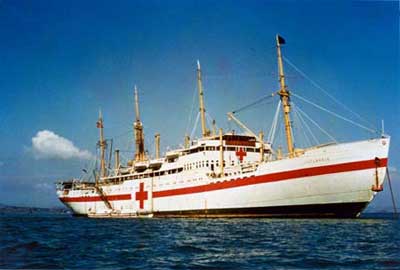
Only a few years after the end of the Second World War, my mother again became involved in another conflict;  the Korean War.  She volunteered with the Red Cross and became a nurse on the Danish hospital ship Jutlandia.

The Jutlandia, pictured to the left, was a fully equipped hospital ship, complete with operating rooms and facilities to treat injured UN and South Korean troops and, along with the captain and crew, a full staff of doctors, surgeons and nurses. My mother spent a year on that ship, but the Jutlandia was actually in service during the entire Korean War. It was really like a MASH unit, if you remember the old TV series of the same name. My mother told stories of how they would go from having to treat an overwhelming number of patients over many hours, sometimes days on end, to having absolutely nothing to do, which, she claimed, almost turned them all into alcoholics because they were bored out of their minds. There were many stories, especially in the Danish newspapers, about the adventures of the Jutlandia and my mother kept many clippings in a scrapbook that I still have.  This picture was taken of my mother and the captain of the ship when he was recovering from an illness:


(I guess cigarettes and alcohol were considered medicinal at the time!)

The Jutlandia was the only hospital ship at the time that also treated Korean civilians at the insistence of the doctors on board.  There were a number of South Korean children who were either injured or who had lost their parents, who were taken on board and fed, clothed and given blankets.  It was a miserable time for so many.

However, my mother seemed to have a lot of happy memories from the ship too, among them the port cities they stopped at on their journey to Pusan, South Korea and back to Denmark again. I still have tiny, paper thin tea cups and chop sticks and silver that she brought from Japan, but there were many other ports of call along the way.

Only a year or two after she arrived back in Denmark, my mother boarded another ship and immigrated to Canada, landing in Montreal and taking the train across the country to Vancouver. She worked as a nurse in several places, having to learn English by the seat of her pants.  One story she told was when she was working near a logging camp near Pender Harbour.  She had a small Danish/English dictionary to help her translate, but when a logger came in one day claiming he had a “bellyache”, she was flummoxed.  And what exactly is a “pain in the nice word for ass”?  Could there be more Canadian cultural shock for a young Danish immigrant?

But she loved Canada and told me that one of her proudest moments was becoming a Canadian citizen.

My mother was 35 when she met my Dad on his bus.  After a short courtship, they married in January 1956 and I was born the following year, July 1957.  They decided not to have any other children, so it was always just the three of us. I had a wonderful childhood with two terrific parents who made me the centre of their universe. It doesn’t get better than that. But my happy little world began to fall apart when my mother found out she had Hodgkin’s Disease, a cancer of the lymph nodes, in 1968. She died on May 25th, 1972.

I often wonder what my mother would think of me now. I still regret that I’m not as great a cook or house cleaner as she was, which sounds silly, I know. When I dust the furniture I inherited from her, I think of how she used to throw up her hands in despair at my laziness, my disaster of a bedroom and my refusal to eat everything on my plate. I know now where all of that comes from, of course, but I was just a stupid kid with no sense of the real world back then. My world was so Leave It To Beaver. There are so many conversations I would have loved to have with her, so many moments I would have been thrilled to share with her. So many questions I would have asked about her life.

But I count myself very fortunate that I had a wonderful mother who, along with my father, taught me so much and gave me such a happy life.  I am proud of who my mother was and what she did in her short time on earth, and I’m especially thrilled when I see some of her qualities blossom in my own children.  As someone pointed out to me recently, they live on in us.

Yes, I can see they certainly do.

I haven’t had the chance to say it in awhile, but Happy Mother’s Day Mama,
All My Love,
Irene

Saturday, May 2, 2015

Freddy Hacks Again


I’m nearly as afraid of him as I am the character Freddy in the movie Friday the 13th.  He doesn’t have the hockey mask, but he does have the chainsaw.

Let me explain that my “fear” is not horror-movie-like. I fear more for my plants.

Every spring, and occasionally in the fall, my husband and I will inevitably come to blows over his so-called hedge “trimming”. The trimming has to be done, no question. But it is the manner in which he approaches his task that I find frightening. There is no preparation, there is no forethought. He plugs the offending instrument in, grinning as he fires it up, and then starts hacking wherever it suits him, flailing the thing around mercilessly. No bush is spared.

Most of the time I know well enough to stay away and work somewhere else, like moving to the back yard when he’s in the front. He will often do his deed when I’m not even at home, likely to avoid my dirty stares and bitter comments. But a couple of weeks ago, he decided to start his hacking right in the area I was working in. Right after I had cleaned things up.

It started out amicably enough. He began on one side of the yard, I was working on the other. There were two very new astilbe plants that had been doing quite well in their new plots just on the other side of the hedge that he was working on. So I decided I would just ask him to be careful and avoid them when he got to that part. He agreed, gleeful sweat already pouring down his face.

I didn’t trust him, so I hung around. And it was a good thing I did. He’d kept to his word and hadn’t trampled on the astilbe. Instead, he let all of the branches he’d cut away fall right on top of them. I was seething as I carefully pulled away the piles of refuse to allow the fledgling plants to breathe. Which brings me to the second most annoying aspect of his hackery. The clean up.

His idea of cleaning up the mess left behind is to take a very large rake and scrape the ground (mostly) clear of dead branches. I say mostly, because the rake doesn’t pick up the little bits. No it doesn’t. I do. Again and again. And again.

I realize that I clearly have a problem. I must remember that it is a very physical task and I appreciate that he does it instead of me. And although he doesn’t plan it out, the hacking usually turns out well once the hedges have recovered from the shock. And I’m just fussier about clean up than he is.

Two weeks have passed and you wouldn’t know the violence and mayhem that had occurred around those bushes. My seething has stopped and life has moved on. Until Freddy hacks again.

IJ

In the last few months I've been driving a family member to and from work, one day a week. It's been a real eye opener to say the le...