Friday, March 26, 2021

A Game Of Tag


Sometimes when I’m out on my daily walk, I find hopscotch boxes or messages drawn in chalk on the sidewalk that make me smile. In the first few weeks and months of COVID-19, there were a lot of messages, especially positive and encouraging ones. Sometimes you’d even find goofy Dad jokes. It was graffiti of the best kind.

Graffiti has been around for thousands of years, discovered on the walls of caves, in ancient Egypt and Greece and the Roman Empire. Most of it was in the form of etched inscriptions or figure drawings. In fact, the word “graffiti” comes from the Italian word “graffiato” which means “scratched”. The things you learn, eh?

Although it was also found in abandoned buildings and bombed out areas in Europe during World War II, what we think of as graffiti today was mostly born out of popular culture and the political movements of the 1960’s and 70’s.

It is not necessarily the same as street art, but the word “graffiti” is often used for both. These days, graffiti is usually word-based, where as street art is image-based. There have been wars between some street artists and graffiti artists for years, especially because street art has been accepted and even invited in certain sections of cities and towns. In most places, however, graffiti and street art are both still illegal. Some of you will recognize the name Banksy, a very famous, British-based street artist whose real identity remains unconfirmed. If you’ve never seen his documentary “Exit Through The Gift Shop”, I highly recommend it.

In and around my neighbourhood, graffiti of the not-so-great kind seems to have become more abundant lately. Tagging, which is more of a way of marking territory, is especially noticeable.

I really don’t like it. I mean, I get it. Freedom of expression and all that. But to me, it’s just plain ugly.

Tags show up on walls, street signs, utility boxes, on buses, fences and pretty much any blank surface outdoors. The tags themselves mean nothing to most of us, only to the small community of people who do it. And the illegality of it doesn’t seem to phase the taggers.

Spray paint has been their medium of choice for many years because of its portability and permanence. It is a pain in the butt to clean because it’s mainly oil-based, so painting over the graffiti is often the only way to clean it up. I’ve seen the same wall of one corner store graffitied and tagged, then painted over and repaired time and time again. It has become some sort of “game of tag”. As soon as the mess is cleaned, they’re at it again.

At one time, Canada Post boxes were one of the blank surfaces constantly targeted by taggers. But you may have noticed in the last few years that mailboxes are now plastered with a jumble of postal codes on all sides, meant to make tagging less visible. Not only that, but the postal codes are actually on an adhesive, which can be peeled off and replaced if it gets too messy. Very clever!

Utility boxes have also been a tagger temptation. But the City of Victoria has started “wrapping” these blank boxes with photos and other scenes to discourage graffiti. Box wraps have also made an appearance in the Burnside/Gorge area, with the Burnside Gorge Community Centre inviting members of the public to come up with designs for utility boxes there. I’m sure this idea will soon become commonplace in most communities.
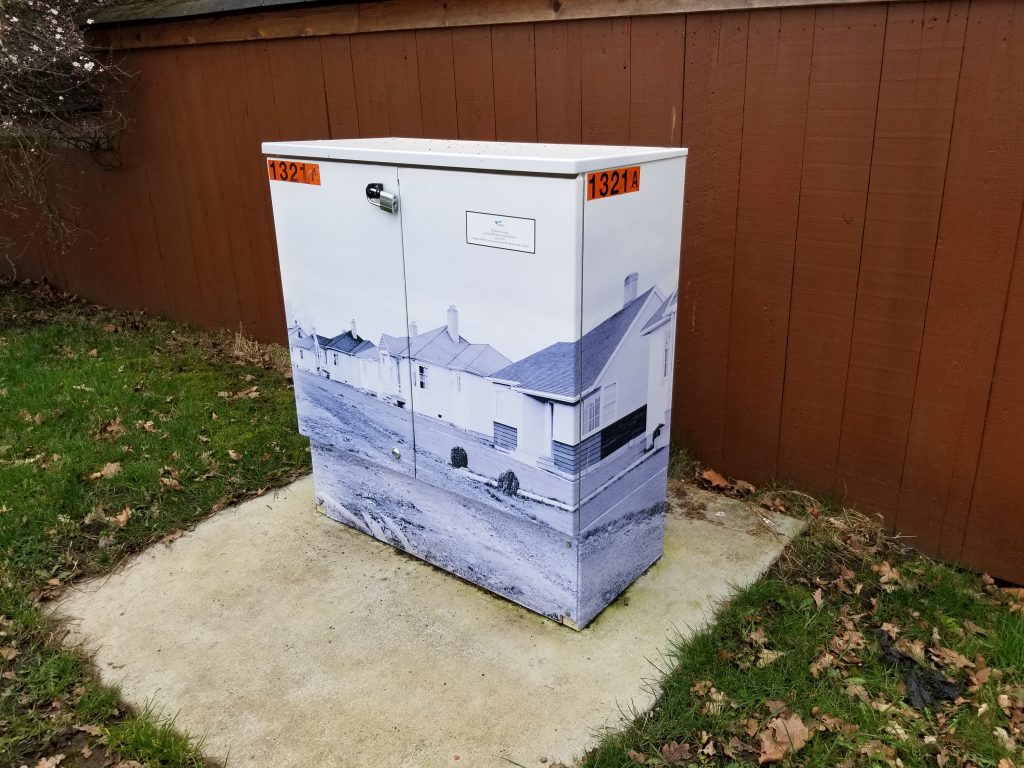
A “wrapped” utility box in the Oaklands neighbourhood of Victoria. (Irene Jackson)

Not only are the box wraps nicer than graffiti, they are also interesting. The photo on the utility box above is the 2800 Block of Scott Street here in Victoria, circa 1947, with its brand new wartime homes. A lot of those old homes are still standing!
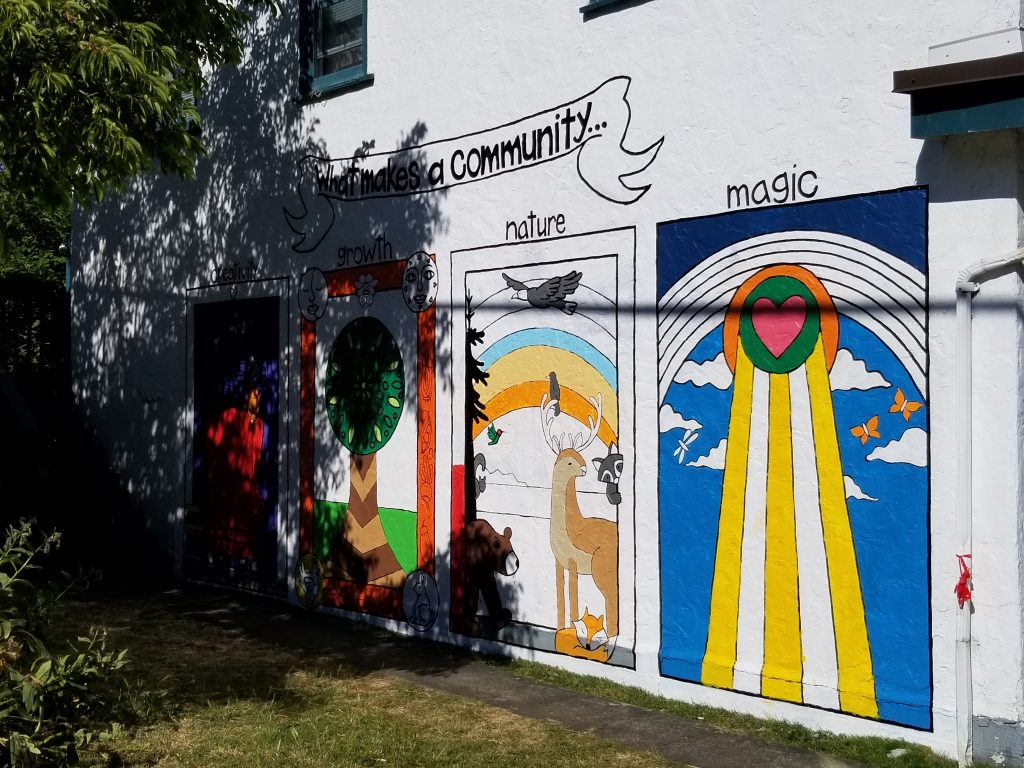
A neighbourhood mural in the works (Irene Jackson)

In my neighbourhood, the wall of one small block of retail stores is now painted with a colourful mural depicting “What Makes A Community”. A group of neighbours started painting it last summer and it is now complete. So far, the taggers have left it alone.

And so it seems that one way to beat them at their own game is to simply be a step ahead of them.

Nothing is going to completely stop taggers from defacing property. In a perfect world, they would have a place where they can legally make their mark, and stay away from everything else. But I think taggers are far more rebellious than that.

Maybe we can convince them to try chalk?

IJ

Monday, March 15, 2021

Has It Been A Year Already?


Well, happy anniversary everyone! We are now officially past the year mark since the W.H.O. declared COVID-19 a global pandemic. And it’s been a year like no other.

Back on March 11, 2020, we couldn’t have imagined what we were in for. COVID-19 was a mystery, and we had no idea what to expect. The phrase “new normal” suddenly became popular.

Our initial reaction to the big shut down was positive, sometimes comical. We can DO this! We hoarded toilet paper. We baked bread, made Quarantinis, and we stood outside every evening at 6pm and banged our pots and pans to honour our health care workers. We laughingly wore pajama pants during video calls. We put hearts and signs of support in our windows for our front line workers, and donated money to local charities like Rapid Relief.

Businesses that sold them, ran out of hot tubs. Gardens flourished, home renovations abounded. We found heroes in people like Dr. Bonnie Henry, whose calm and compassion gave us much comfort. A global pandemic wasn’t going to keep US down!

Then reality kicked at us a little harder. The novelty began to wear off. Day after day we somberly donned our masks, washed our hands, and kept our distance from each other. Well some of us did. Others screamed in protest. Tempers flared. And all the while, more and more people were getting sick or dying.

Our hair grew long, beards became unruly. Zoom calls that started out as great fun, began to wear on us. Living and working and learning at home got more and more boring and intolerable for many. Not being able to see or hug our family and friends was depressing us. In fact, anxiety and depression was on the rise in all age groups, but especially in young people. We were exhausted. And all of this happened before winter had even hit.

As we said goodbye with great relief to 2020, COVID continued its ominous advance. New cases and new variants sprang up everywhere when a second wave hit. Long, dark days with no end to this pandemic in sight, left us mourning and miserable.

But there were some small hints of hope. Pharmaceutical companies around the world who had been working around the clock to come up with a vaccine, started to have some success. A few countries that were initially hit hard by the pandemic, were beginning to see their COVID numbers level off, or even come down as a result of shut downs. There was just a little bit of light appearing at the end of that very long tunnel.

And now spring is almost here. As of March 12th, almost 3 million vaccines have been administered in Canada. We have, most of us, adapted to this new reality, to the shut downs, the social distancing, and the masks. Handwashing and sanitizing is more habitual. But we are so looking forward to the day when we can actually spend time together in person again, and that day comes ever closer. Still, as the expression goes, the last few miles of a marathon are the hardest.

I know, I know. Kilometers.

So what have we learned from this past year so far? I would venture to guess it will take a long time to completely assess that. Businesses, governments and communities will gather their list of lessons learned. As individuals, we will each write our own epilogues. Ultimately, you might say that we are forever changed.

But in spite of it all, babies were still being born and people were still marking milestones. All this time, life was forging ahead and hopeful. And now, here on the west coast, the trees are starting to burst new buds, robins are laying their eggs, and cherry blossoms are blooming.

And vaccines are here. At long last. Ah, spring.

IJ

Friday, March 5, 2021

Hot Pot Politics


I don’t think I could handle being a politician. In fact, I’d guess that the majority of us couldn’t handle it. And wouldn’t want to.

All you have to do is peruse the “letters to the editor” page in any paper, or scroll through Twitter and news feeds, and you immediately see why. Many people despise politicians, and no matter what mayors or premiers or prime ministers try to do, somebody’s going to be in a rage.

These days, that vitriol seems even more intense. Some of it, I’m sure, is because we are living through an exceptionally stressful time and leaders of any sort are an easy target for that pent up frustration.

Some of it, though, is because these days it seems we have been given permission to be hateful.

Those of us who live here in Victoria, the provincial capital, are pretty close to the political action when it fires up. Many of my students and friends over the years have been government employees in one capacity or another, so I’ve heard lots of stories, good and bad, about the people who run our government.

I became involved in a campaign many years ago when someone talked me into volunteering for a political party during a provincial election. I was pretty young and naïve, and I thought it would be kind of exciting. Well, it certainly was an eye opener.

One of my first jobs was canvassing, which meant going to a designated area within the riding and knocking on every door in the neighbourhood. A lot of volunteers didn’t like canvassing, for reasons I was about to find out. But I was game.

To be fair, many people whose doorbells I rang were polite and took the leaflet I handed them with a smile. But there were others who called me every name in the book, some even slamming the door in my face. It was humiliating. And here I was, thinking I was doing something positive and helpful.

I was supposed to canvass the whole area three times during the course of the campaign, but I think I probably only managed one cycle. That was enough for me.

I also worked the telephones at campaign headquarters. One day, our candidate walked in to meet with all of the office workers and volunteers. He made the time to come up and sit by my desk, chit chat a little, and thank me for volunteering. I immediately liked him and was suddenly filled with that sense of purpose I’d been seeking. Our little chat was the best thing about the whole campaign for me.

Years later, that candidate became the Premier of B.C.

There are many good people out there who truly want to make a difference in their community, province or country. They work hard and they put in long hours, often against all odds, to effect change. They are the ones who are passionate about their work, who try to reach across the aisle and find compromise. They’re the ones who will sit down at the desk of a lowly campaign worker and sincerely thank them for their efforts.

But as sincere and as passionate as these people might be, even if they succeed at getting something done, sometimes they just can’t win. Somebody’s always going to be seething.

Maybe we should consider being a little kinder to them. We can certainly disagree, but don’t make it personal.

Oh, I know there are the bad apples too: those with a sense of entitlement who care more about themselves and their rise to the top than they do their constituents. But that will always be true, in any career.

What I really hope for is that there will be enough younger people interested in fulfilling those important rolls in the future, because we really do need them. Experience is one thing. A fresh, new outlook is another. And hopefully, they’ll have a thicker skin than I did when they go out on their first round of canvassing.

The only constituents I have to deal with these days are the members of my household. We disagree on a lot of things sometimes, but when it comes to Sunday dinner, this is an autocracy. I hold all the power.

IJ

Libraries Are Not Just For Books

  There was a news story recently about a book that was finally returned to the Vancouver Public Library, 50 years overdue. What surprised m...